Anti-static record brush: what velvet does, and what it does not
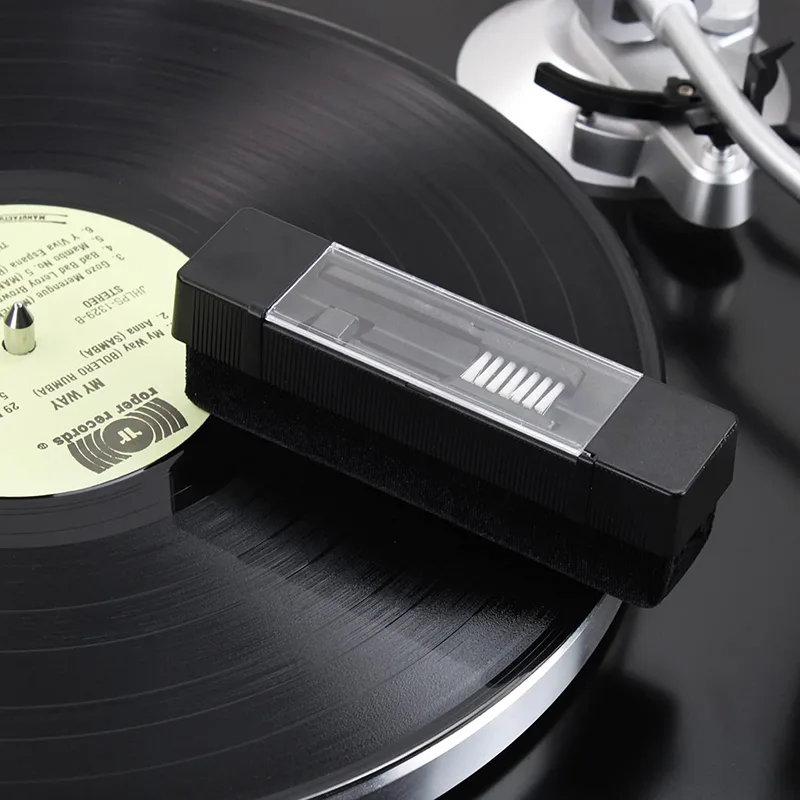
Why a record builds a charge at all
The mechanism is contact electrification, the same effect behind a balloon sticking to a wall. When two dissimilar materials touch and separate, electrons move across the boundary and one surface finishes with a surplus. Vinyl sits toward the electron-grabbing end of the triboelectric series, which is why it so reliably ends up charged rather than neutral after a rub against paper or polyethylene.
Playback keeps the process running. The stylus is in continuous friction with both groove walls for the length of a side, and it is doing that on an insulating surface at room humidity. By the time the arm lifts, the record has spent twenty minutes generating charge and pulling every airborne particle in the room toward itself. The crackle you hear on the next play is that dust, now sitting in the groove, being run over by a diamond.
Room conditions decide how bad it gets. Dry air is the enemy. Below roughly 30% relative humidity, charge builds quickly and discharges without warning, which is the season when records start grabbing dust the moment they leave the sleeve. Our record storage guide covers the humidity side in more detail.
What the velvet face actually does
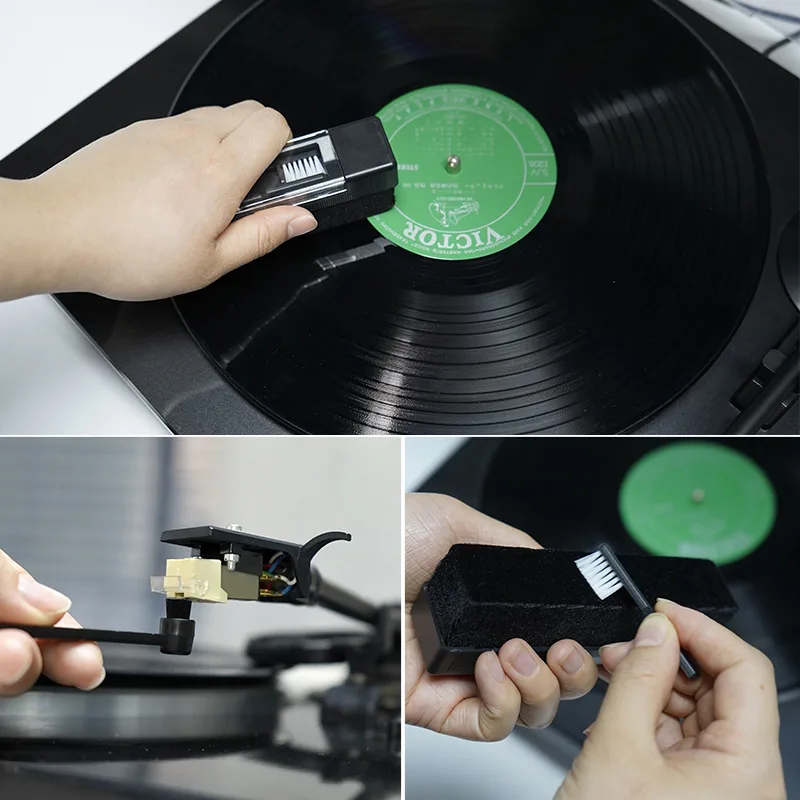
Two properties do the work. The first is softness: the fibers are far more compliant than the vinyl they touch, so they deform around a particle instead of dragging it. The second is the nap itself, which behaves like a very shallow trap. Dust that a stiff wiper would push into a ridge at the edge of the stroke ends up buried between fibers instead.
Behind the nap is a firm cushion, not a row of bristles. Buyers notice this and some say it plainly: one wrote that it is not made of bristles, more like a hard foam covered with a cloth suited to the job. That is an accurate description of the product. The cushion is what keeps pressure even across the whole face rather than concentrated on a few bristle tips.
The clear cover slides on top and does two things. While you sweep, it is the handle, which keeps fingers off both the velvet and the record. In the drawer, it is a lid, which is the only reason a velvet pad survives being stored next to keys and loose change.
What velvet does, and does not do, about static
This matters when you compare tools. A carbon fiber brush uses conductive filaments and often a metal spine, so touching the metal while the fibers are on the record gives charge a route out through your hand. That is a real mechanism, and it is the reason to own one. An anti-static gun goes further by firing ions at the surface. Neither of those is what a velvet pad is.
| Tool | How it treats dust | How it treats charge | Weak spot |
|---|---|---|---|
| Velvet face (this set) | Wide contact band traps loose surface dust in the nap | No conductive path; it removes the effect, not the cause | Needs re-combing, and it does not reach the groove floor |
| Carbon fiber brush | Thin filaments reach further into the groove | Conductive fibers can carry some charge away through a metal body | Narrow contact area, and fibers shed over time |
| Anti-static gun | Removes nothing on its own | Sprays ions that neutralize the surface directly | Costs several times a brush and still needs a brush afterward |
| Humidity control in the room | Removes nothing | Raises surface conductivity so charge leaks away on its own | Slow, indirect, and it changes the whole room |
The long version of the first two rows is in carbon fiber versus velvet record brush, including where the carbon side genuinely wins.
What buyers said about the velvet face
Themes across the 47 written buyer reviews (July 2026). The overall score is 4.6 out of 5 across 151 ratings.
| What they said about the face | Reviews | Share |
|---|---|---|
| It removes dust as expected | 9 | 19% |
| It is a pad, not bristles | 4 | 9% |
| Build quality of the block | 5 | 11% |
Four buyers out of forty-seven expected bristles and found a velvet-covered cushion. None of them said it worked badly. They said it was not what the photo led them to expect.
Three numbers worth knowing
Relative humidity below which static charge builds fast and discharges unpredictably
— Electrostatic Discharge Association, humidity guidance, 2026
Relative humidity the Library of Congress recommends for storing recordings at home
— Library of Congress, Care, Handling and Storage of Audio Visual Materials, 2026
Diameter at and below which the EPA classes indoor particulate as inhalable, small enough to sit inside a groove
The sweep that does not add charge
Lifting matters more than most people think. Dragging the block off the edge deposits the dust you just collected back onto clean vinyl, usually in a visible line near the run-out. Lifting vertically keeps everything you gathered inside the nap where it belongs.
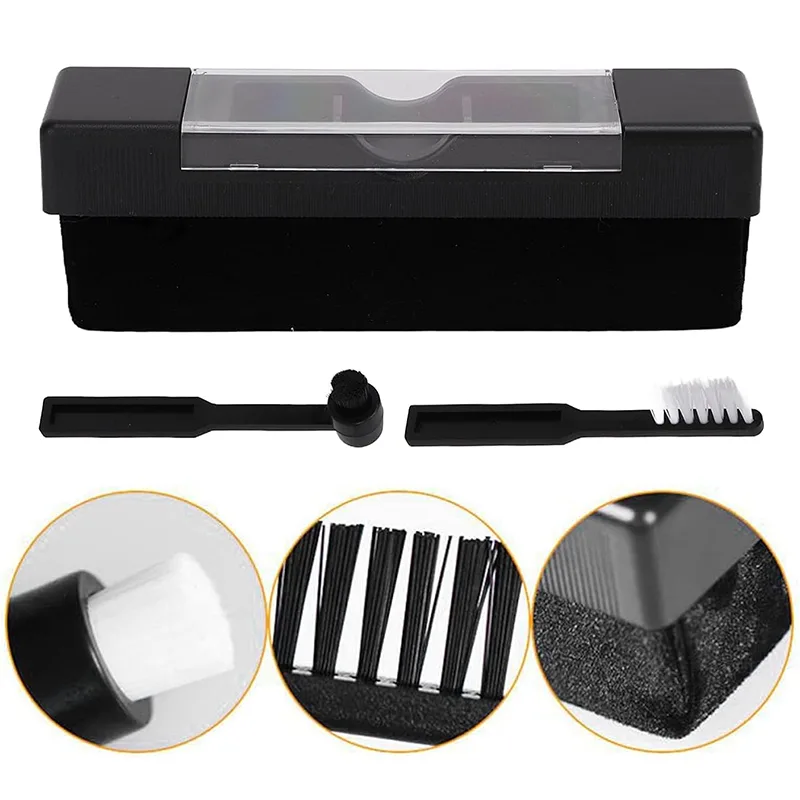
Then re-comb the pad. Run the white nylon detail brush across the velvet and the collected load lifts out. When the pad reads gray rather than black, it has stopped being a cleaning tool and started being a dust applicator. Combing it takes three seconds and it is the difference between a brush that works for years and one that works for a month.
The stylus needs the same attention on a completely different rule, one that has nothing to do with static and everything to do with not bending a cantilever. That is on the stylus brush page. For the full weekly rhythm see the vinyl record care routine, and if you are dealing with second-hand records that need more than a dry sweep, start with the record cleaning kit comparison or the guide to cleaning vinyl records properly.
Anti-static brush questions
Does an anti-static record brush actually remove the static charge?
A velvet brush removes the dust that the charge attracted. It is not a grounded conductor, so it does not drain the charge itself. Brushes built with conductive carbon fibers and a metal body can bleed some charge away when your hand touches the metal. This one is velvet on a plastic body, so it removes the dust, not the charge.
Why does my record crackle and attract dust straight out of the sleeve?
PVC is an electrical insulator, so charge that lands on it stays put. Sliding the disc against a paper or plastic inner sleeve separates surface charges, and the stylus dragging through the groove adds more. The charged surface then pulls airborne dust toward it and holds it there until something lifts it off.
Is velvet or carbon fiber better for an anti-static brush?
They do different jobs. Carbon fiber bristles are thin enough to reach into the groove and can carry a little charge away through a conductive body. A velvet face has far more contact area and sweeps a wide band of loose surface dust in one pass. Many collectors own both and use them for different problems.
Does the brush add static while I use it?
Any dry material rubbed against PVC can separate charge, velvet included. Two habits keep it small: sweep with the platter turning rather than scrubbing back and forth, and lift the block straight up instead of dragging it to the label. Fewer strokes means less friction and less charge.
Will low humidity in my listening room make static worse?
Yes, noticeably. Static control guidance puts the trouble zone below about 30% relative humidity, where charge builds fast and lets go unpredictably. The Library of Congress advises roughly 35 to 40% for storing records at home, which is dry enough for the media and damp enough to take the edge off static.
Where to go next
- The three-piece record cleaning brush set — the full product page with specs and buyer photos.
- Record cleaning kit — the four kit categories and what each one really costs.
- Stylus brush — the one stroke direction that protects the cantilever.
- Carbon fiber vs velvet record brush — the comparison in full.
- How to store vinyl records — humidity, sleeves and shelf position.
- About Tonebrush — who writes the guides.