How to Clean a Record Player Needle Without Breaking It
Updated on
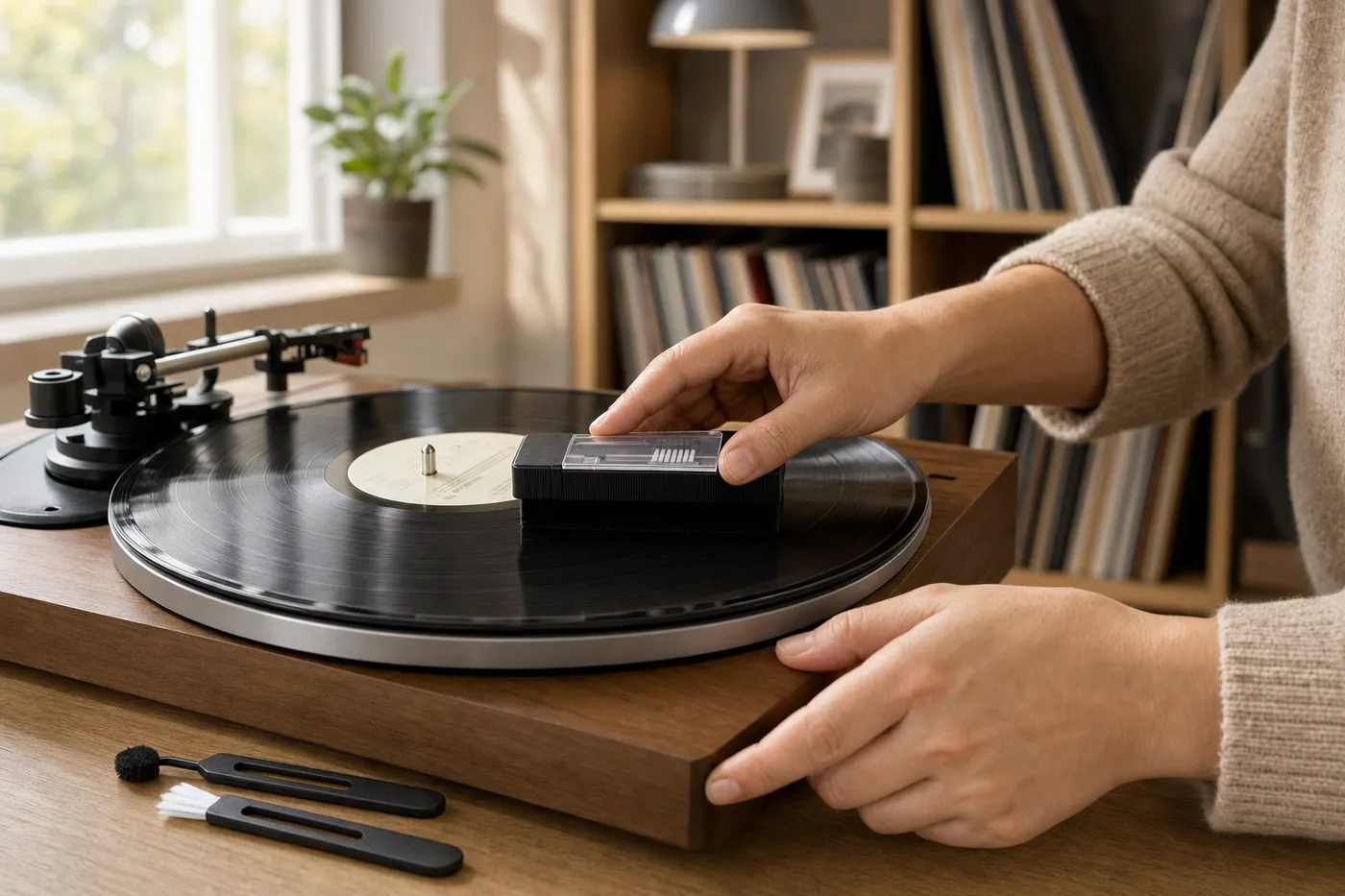
The needle on a record player is not really a needle. It is a diamond tip a fraction of a millimeter across, glued to a thin tube called the cantilever, which is suspended in rubber so it can move freely in two axes. That suspension is what turns groove wiggle into music, and it is also what makes the assembly so easy to ruin. The tip is the hardest material on the turntable. Everything holding it in place is delicate.
This is why stylus cleaning is the one maintenance job where technique beats product. A collector with the cheapest brush and the right motion will keep a cartridge alive for its full rated life. A collector with an expensive gel pad and a careless hand can bend a cantilever in one second and never know it happened until the channel balance drifts. The direction of the stroke is the whole discipline.
Always back to front, never sideways
Ortofon instructs brushing "from the rear of the cartridge toward the stylus tip and never from stylus tip to the rear of the cartridge and never from side to side"
— Ortofon stylus care guidance, 2026
The cantilever is engineered to move up, down, and laterally against a compliant suspension. It is not engineered to be pushed backwards along its own axis, and it is least happy being shoved sideways at the tip, where the leverage is greatest. A back-to-front stroke loads the assembly the same way a record groove does, which is the direction the whole thing was designed to take.
The physical routine is short. Cue the arm up and lock it, or leave it resting on the rest with the lock open if you have steady hands. Work in good light, because you need to see the tip. Set the brush behind the stylus, make contact with the bristles rather than the handle, and draw it forward three or four times in a single unhurried direction. Lift the brush clear at the end of each stroke rather than dragging it back through the tip.
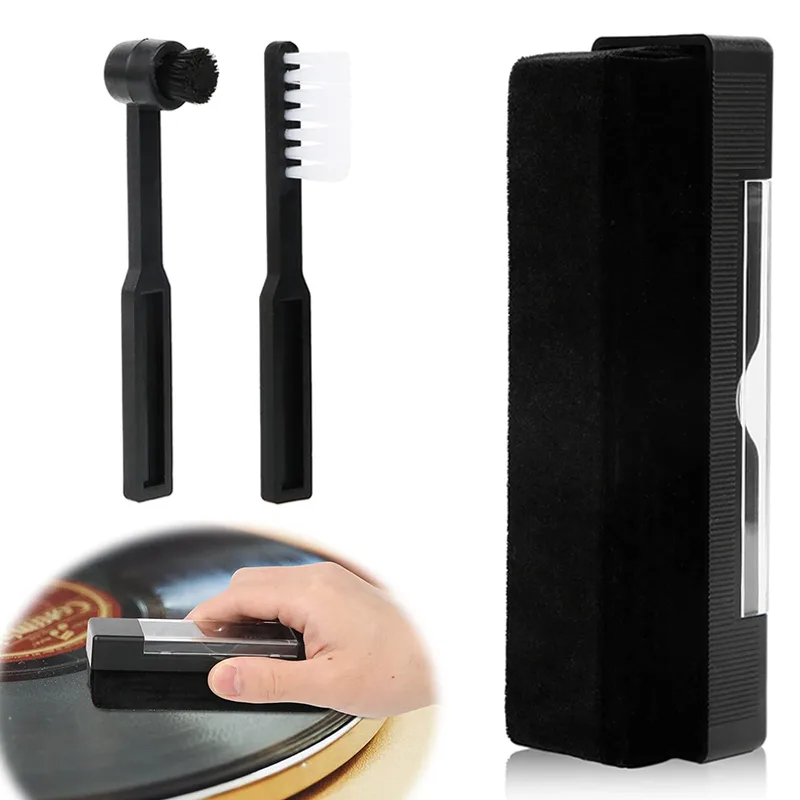
Our own stylus brush is the small angled piece in the three-piece set. It measures 2.4 in (6 cm), the flat black handle is pierced with a long oval so it is easy to hold at a shallow angle, and it is bent near the tip so the round head of black bristles meets the stylus without your fingers getting in the way of the light. There is more on it on the stylus brush page.
How often to clean a stylus
Frequency is also an economic argument. A diamond does not wear out on a schedule. It wears out under load, and debris packed around the tip increases that load while adding an abrasive to the contact. Manufacturers publish replacement intervals that assume reasonable care.
stylus replacement intervals published by tip shape, from around 300 hours for conical and elliptical tips up to about 1,000 for microlinear
— Audio-Technica cartridge and stylus support guidance, 2026
The way to make the cheap habit pay is to stop the dust reaching the stylus in the first place. A record dusted before it goes down transfers far less to the tip, which is the connection between this page and how to clean vinyl records. Cleaning the disc and cleaning the diamond are the same maintenance loop viewed from two ends.
(15-25 µm) tip radius range archives use for microgroove LPs, small enough that a single fiber sitting on the tip is a large object
— IASA TC-04, section 5.3, 2009
Liquids, gels, and what they risk
| Method | What it removes | Risk | Verdict |
|---|---|---|---|
| Dry brush, back to front | Loose dust, lint, most of what accumulates in a session | Low, provided the direction is right | The default, every session |
| Liquid stylus cleaner, one drop on the brush | Packed residue a dry brush leaves behind | Fluid running up the cantilever toward the glue joint and suspension | Occasional, sparingly, brush dipped and shaken off |
| Gel or resin pad, lowered onto the tip | Sticky and packed debris, in one vertical press | Lifting the pad sideways, or letting the arm drop onto it | Effective if you move only vertically |
| Isopropyl alcohol at full strength | Almost anything, including things you need | Solvents attack adhesives and rubber parts inside the cartridge | Avoid unless your cartridge maker names it |
| Household abrasive sponges | Debris, and diamond mounting integrity along with it | Abrasive contact with the tip and lateral force on the cantilever | No |
| Fingers, paper, or a cotton swab | Nothing reliably | Fibers snag the cantilever, oils transfer to the tip | No |
If you use a liquid, apply it to the brush and not to the stylus, wipe or shake off the excess so the bristles are damp rather than wet, then use the same back-to-front stroke. Give it a minute to evaporate before you play anything. Whatever your cartridge manufacturer says about its own product overrides everything on this page.
Signs your diamond is dirty
The reliable visual check is a small light and a phone camera in macro mode from the side and slightly below. A clean tip looks like a bright point. A loaded one looks like a gray or brown collar around the tip, sometimes with a visible fiber wrapped around the cantilever. That fiber is worth mentioning on its own, because it is the classic cause of a sudden channel imbalance and it comes off with two careful forward strokes.
One caution about diagnosis. Every symptom above can also come from a worn stylus, a mistracking setup, or a genuinely dirty record. Clean the stylus first because it costs nothing, then clean the record, and only then start suspecting the cartridge. The order of operations saves people a lot of money.
Short answers
Can I clean a stylus with rubbing alcohol?
Not at full strength, and not as a habit. Solvents can reach the adhesive holding the diamond to the cantilever and the rubber suspension inside the cartridge. Use a dedicated stylus fluid in a very small amount on the brush, and follow whatever your cartridge maker publishes for that model.
Which way do you brush a record player needle?
From the back of the cartridge toward the tip, in the direction the record moves under the stylus. Never from the tip backwards and never side to side. A lateral stroke puts force on the cantilever exactly where it has the most leverage to bend it.
How do I know when to replace the stylus rather than clean it?
Track your hours. Published intervals run from roughly 300 hours for conical and elliptical tips to about 1,000 for microlinear shapes. If distortion persists after cleaning the stylus and the record, and you are near that range, the diamond is worn and no cleaning method restores it.
A brush for the diamond, and one for the disc
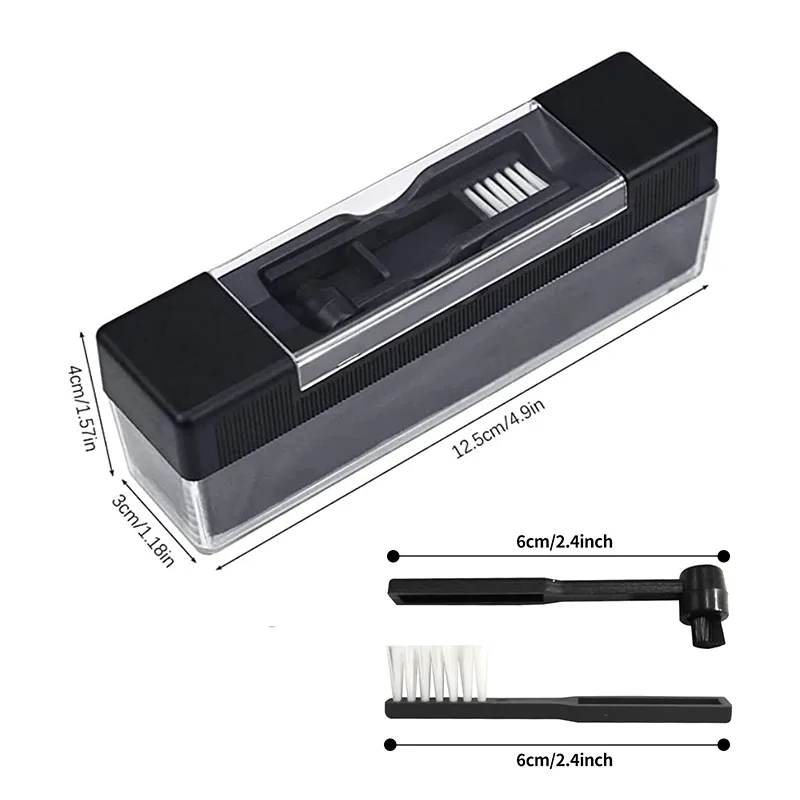
The stylus brush in our set is one of three pieces. The velvet block handles the record before it goes down, the stylus brush handles the diamond, and the white nylon detail brush keeps the velvet working. See the whole set on the record cleaning kit page, or read what buyers reported on the reviews page.
More guides: all Tonebrush guides · the full care routine · how to store vinyl records · anti-static record brush · about Nick Talbot