How we test record cleaning brushes
Five criteria decide whether a record cleaning brush suits you. Here is each one, and how the Tonebrush set answers it.
Our criteria
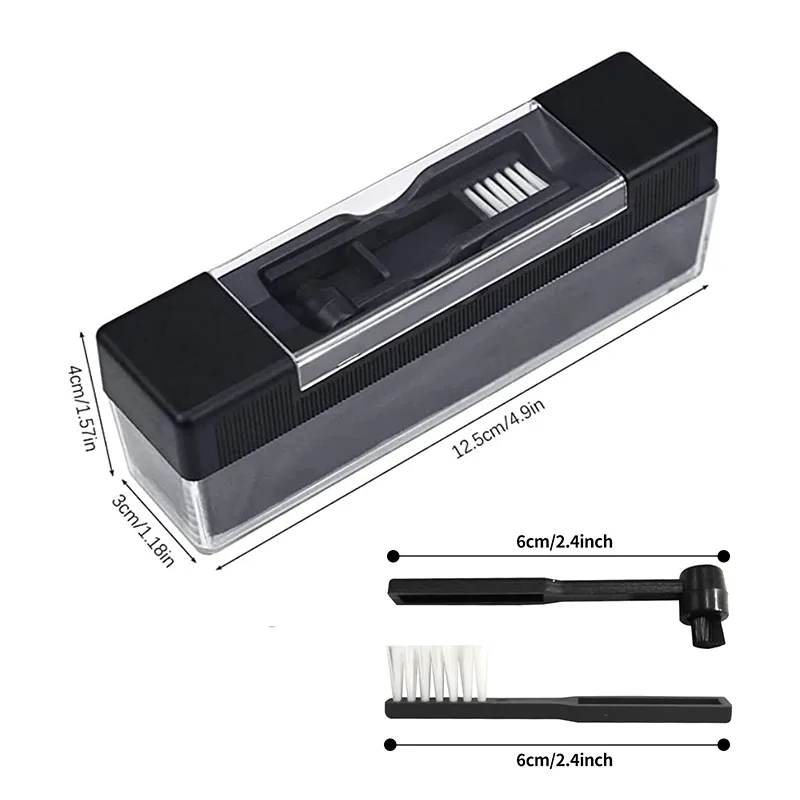
- The contact surface. Velvet pads present a wide flat face and lift loose dust by contact; carbon fiber brushes reach with rows of fine conductive filaments. The Tonebrush block is a firm pad with black anti-static velvet on its long faces, 4.9 in (12.5 cm) long, so one slow pass covers the full radius of a side.
- A tool for the stylus. Dust swept off a record still ends up on a dirty stylus tip. The set includes a 2.4 in (6 cm) stylus brush with a flat angled handle and a round head of soft black bristles, used back to front only.
- A way to clean the brush. A velvet face that is never combed moves lint from one record to the next. The white nylon detail brush, 2.4 in (6 cm), combs the velvet clean when a gray line forms.
- Storage. An uncovered brush collects room dust on the shelf. The transparent sliding cover closes over the velvet between sessions and doubles as the handle, so your fingers stay off the velvet.
- Compatibility and limits. The set is listed for 33, 45 and 78 RPM records and for CDs. A dry brush lifts loose surface dust before the needle reaches it; fingerprints, mold and old residue need a wet clean.
What buyers report
The set is rated 4.6 out of 5 across 151 ratings: 126 five-star, 11 four-star, 5 three-star, 2 two-star and 7 one-star. Across the 47 written reviews, dust removal is the most mentioned theme at 9 reviews, followed by description accuracy at 6, fast delivery and build quality at 5 each, and value at 4. Four buyers note that the large piece is a pad rather than bristles, and three found delivery slow. The full table is on the reviews page.
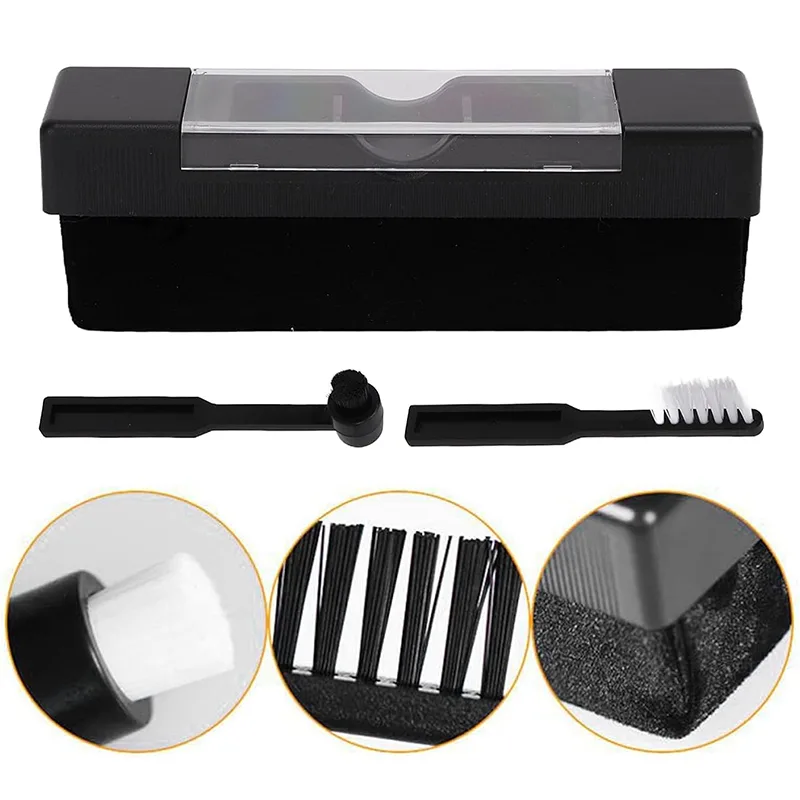
The three pieces
| Piece | Length | Working surface |
|---|---|---|
| Velvet block with sliding cover | 4.9 in (12.5 cm) | Black velvet face on both long sides |
| Stylus brush | 2.4 in (6 cm) | Round head, black bristles |
| Detail brush | 2.4 in (6 cm) | Straight head, white nylon bristles |
Body material is black ABS. Packed weight is 3 oz (85 g). The set is listed for 33, 45 and 78 RPM records plus CDs.
The large piece is a firm block with a velvet face, not a brush with bristles; the two small brushes carry the bristles. The difference against the other common material is set out in carbon fiber versus velvet.
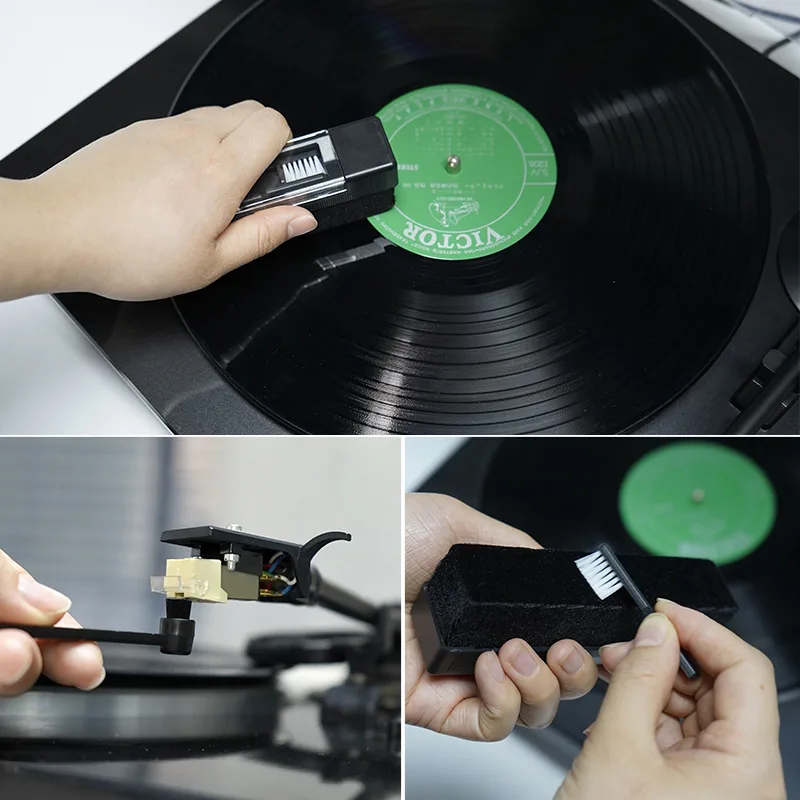
In daily use
A sweep before the needle drops, the detail brush across the velvet when the pile turns gray, the stylus brush back to front every few sides. The habits are written out in how to clean vinyl records and the record care routine. The clear cover slides off and doubles as a handle, so your thumb stays out of the velvet, and in a dusty room the block loads up quickly, which is what the white nylon brush is for.
What this changes for you
You get the dimensions up front and a straight answer about what a dry brush does and does not do. Shipping is free, orders leave in 1 to 2 business days and arrive in 6 to 10, and every order is covered by a 30-day money-back guarantee. The details sit in our shipping policy and refund policy.
The guides are written by Nick Talbot, introduced on the about page. The product itself is on the homepage, with the components broken out on the record cleaning kit page, the anti-static record brush page and the stylus brush page.