Record cleaning kit for vinyl: the three-piece dry set
What is actually inside a vinyl record cleaning kit?
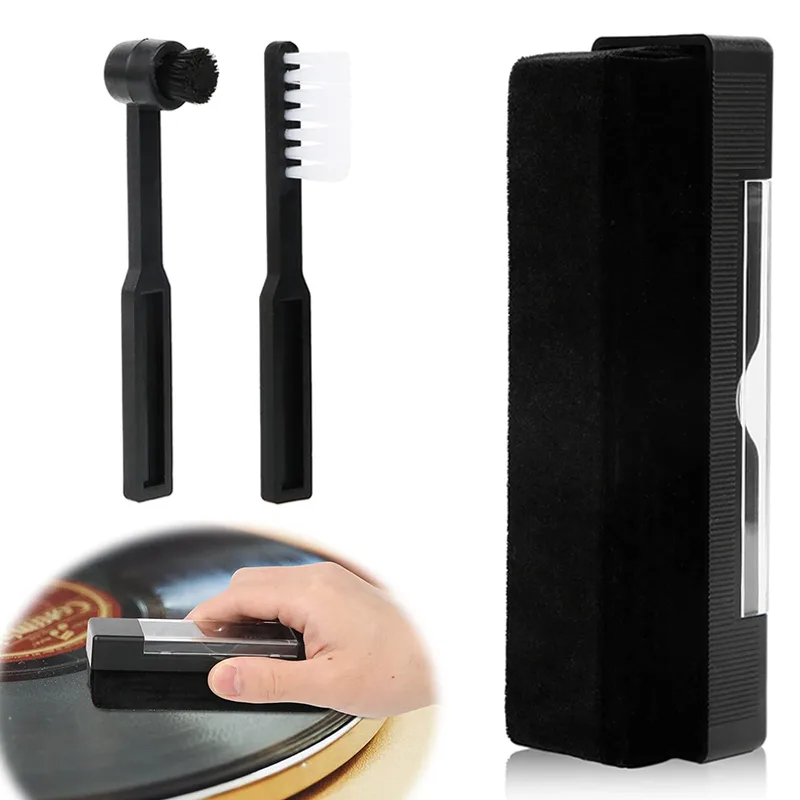
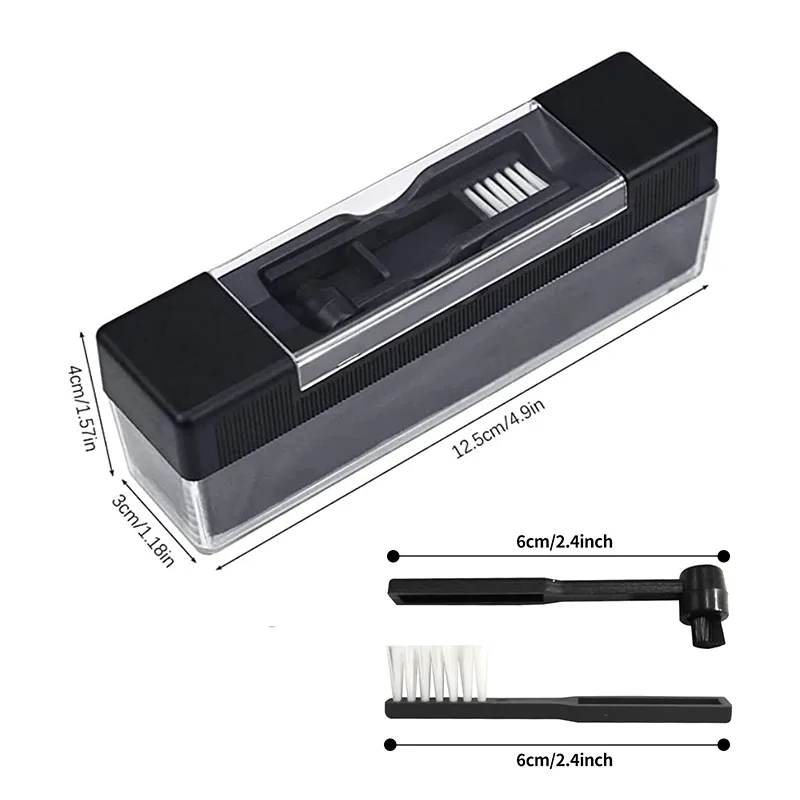
The first piece is the velvet block. It measures 4.9 in (12.5 cm) long, 1.18 in (3 cm) wide and 1.57 in (4 cm) tall, and its two long faces are covered edge to edge in black velvet. It is a firm cushion wearing velvet, not a row of bristles, and that distinction matters enough that several buyers wrote about it unprompted. A clear cover slides onto the top. The cover doubles as the handle while you sweep and as a lid that keeps the pad clean between sessions.
The second piece is the stylus brush: a flat black handle 2.4 in (6 cm) long, pierced by a long oval, bent near the tip, finished with a round head of black bristles. It has a home on the back of the velvet block, so the small piece that is easiest to lose lives with the big piece that is hard to lose. Its full method is on our stylus brush page.
The third piece is the detail brush: same 2.4 in (6 cm) flat handle, straight instead of bent, tipped with white nylon bristles. It is not for the record. It is for the velvet. After a few dozen sweeps the pad holds what it collected, and dragging the nylon bristles across the nap lifts that load back out. Skip that step and you are wiping a record with the last record's dust.
The four kinds of record cleaning kit, and what they cost
| Kit type | Typical US price | Handles | Does not handle |
|---|---|---|---|
| Dry brush kit (velvet or carbon fiber, plus stylus brush) | about $15 to $40 | Loose surface dust and lint, before and after every side | Fingerprints, grease, mold, anything already pressed into the groove |
| Spray and wipe kit (fluid, pad or cloth, brush) | about $20 to $60 | Light fingerprints, smears, a lightly grubby second-hand record | Deep groove contamination; it also leaves residue if you overdose the fluid |
| Manual bath washer (tub, rollers and fluid) | from about $80 | Batch cleaning a crate of thrift finds properly, with drying by hand | Nothing fast; it is a tub, and every record has to be dried |
| Vacuum machine | about $499 to $1,200 | Wash and suction dry in a minute or two per side | Quiet operation, and a small budget; most models are loud |
| Ultrasonic cleaner | from about $380 | Contamination sitting at the bottom of the groove wall | Casual use; it is a machine you set up, not a tool you grab |
Typical US retail prices, July 2026. They move. Treat them as bands, not quotes.
These categories are not rivals so much as stages. Nobody runs an ultrasonic bath before every side. Owners of $1,200 machines still keep a brush next to the platter, because the machine cleans the record once and the brush keeps it clean for the next forty plays. If you are buying your first tool, buy the one you will use every day.
What a dry kit does not do
So the sequence for a crate of estate-sale records is: wet wash first, dry fully, then dry brushing from that point on for the rest of the record's life. Our guide to cleaning vinyl records walks through the wet step with household-safe materials, and the care routine guide sets out what to do weekly versus what to do once.
There is a second thing a dry kit cannot do: it cannot fix a record that is already scratched, warped or worn. Groove damage is missing material. Cleaning removes what should not be there. It cannot put back what a previous owner's mistracking cartridge shaved off.
What 47 buyers actually wrote about
Themes across the 47 written buyer reviews (July 2026). The overall score is 4.6 out of 5 across 151 ratings.
| Theme raised unprompted | Reviews | Share |
|---|---|---|
| Dust removal works | 9 | 19% |
| Matches the description | 6 | 13% |
| Fast delivery | 5 | 11% |
| Build quality | 5 | 11% |
| Value for money | 4 | 9% |
| It is a pad, not bristles | 4 | 9% |
| Slow delivery | 3 | 6% |
Two of those signals are complaints. Three people found shipping slow. Four expected bristles on the big piece and got a velvet-covered cushion.
The numbers behind the category
US vinyl revenue in 2025, past $1 billion for the first time since 1983
— RIAA Year-End Revenue Report, 2026
Using the kit takes about twenty seconds
Lift the block off rather than dragging it toward the label, because dragging pushes the collected dust across clean vinyl. If your platter is not spinning, sweep along the groove in a slow arc instead of straight across it, following the direction the stylus travels. Never scrub back and forth; that is how you turn loose dust into abrasive.
The stylus is a separate motion entirely and a strict one: back to front only, from the rear of the cartridge toward the tip. Sideways or backwards strokes push against the cantilever's suspension. Full detail sits on our stylus brush guide and in the article on cleaning a record player needle.
If you want the reasoning behind the velvet face rather than the method, the anti-static record brush page explains what static actually is on a PVC disc and what velvet can and cannot do about it. The material argument is in carbon fiber versus velvet.
Record cleaning kit questions
Is a three-piece dry kit a complete record cleaning kit?
It is complete for maintenance, which is what most listeners need. It covers the two surfaces that collect dust between plays: the record face and the stylus. It is not complete for restoration. A thrift-store record with fingerprints, mold bloom or old grease pressed into the groove needs a wet wash first, then this kit takes over.
What is the difference between a record cleaning kit and a vinyl cleaning kit?
Nothing. Sellers use both names for the same category, and shoppers search both. A vinyl cleaning kit and a record cleaning kit both describe a bundle that cleans the disc surface and usually the stylus too. What actually differs between products is the method: dry brushing, spray and wipe, bath washing, vacuum, or ultrasonic.
Do I need cleaning fluid with this kit?
No fluid ships with the set, and the set does not need it to work. The velvet face lifts loose dust dry. If you want to add a fluid later you can, but keep it off the label and off the stylus. Ortofon states plainly that it does not recommend solvents of any kind on either a record surface or a stylus.
Will the kit work on 45s and old 78s?
Yes. The set is listed as compatible with 33, 45 and 78 RPM records, and it works on CDs too. The velvet block is 4.9 in (12.5 cm) long, which covers the playing area of a 7 in single in a short sweep and a 12 in LP in a slow arc as the platter turns.
How often should I use it?
Sweep the record before each side and brush the stylus at the same time. That habit takes about twenty seconds and stops most dust from being pressed into the groove in the first place. Re-comb the velvet with the white nylon brush whenever the pad looks gray rather than black.
Where to go next
- The three-piece record cleaning brush set — the full product page, specs and buyer photos.
- Anti-static record brush — why PVC holds a charge, and what velvet honestly does about it.
- Stylus brush — the back-to-front stroke, and the mistakes that bend a cantilever.
- How to clean vinyl records — the wet step a dry kit cannot replace.
- How to store vinyl records — keeping them clean once they are clean.