Carbon Fiber vs Velvet Record Brush: A Comparison
Updated on
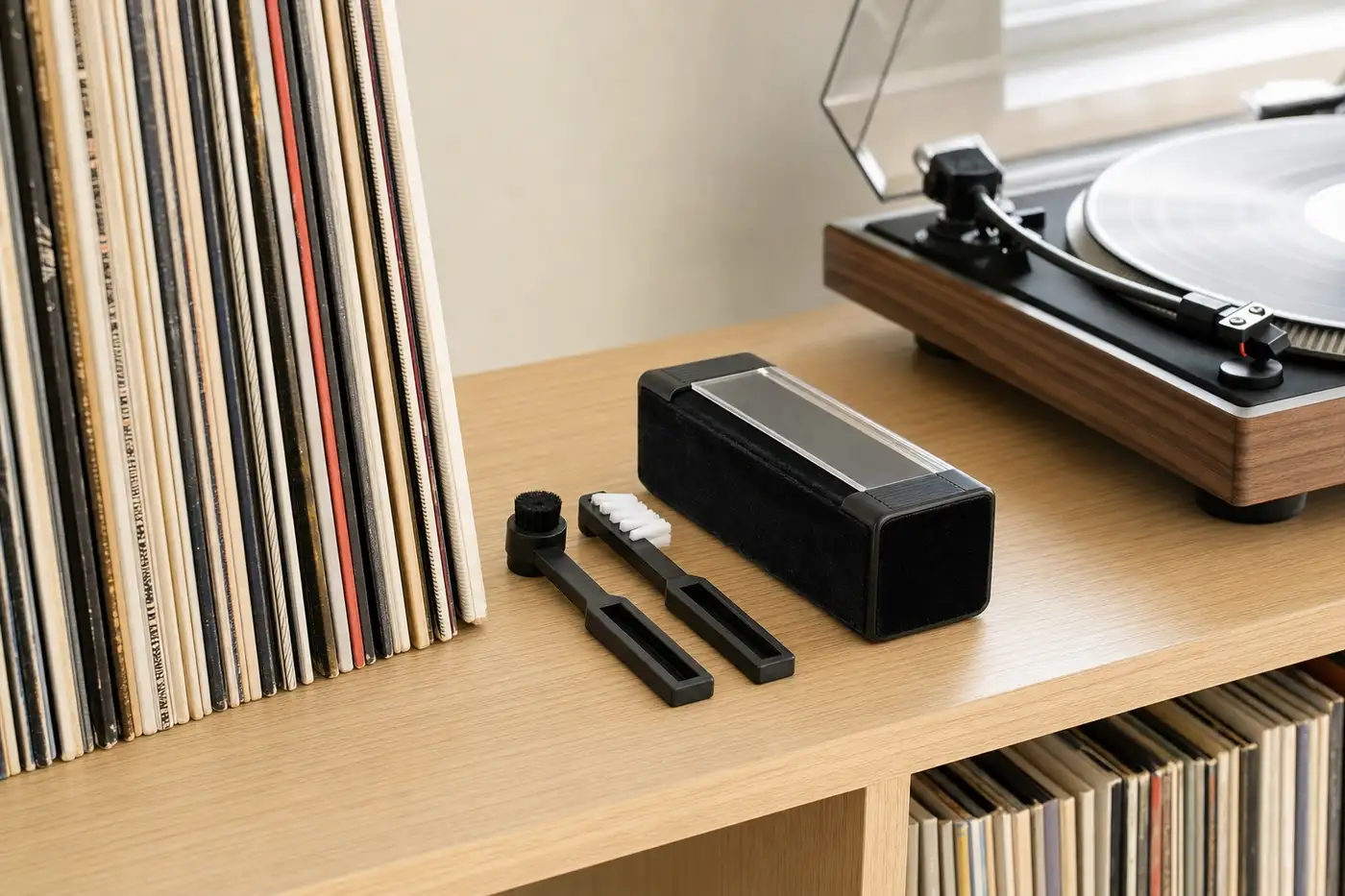
Two designs have dominated record brushes for forty years, and they solve the same problem in genuinely different ways. One is a row of extremely fine conductive filaments on a hinged handle. The other is a firm pad wrapped in short, dense velvet. Collectors tend to be loyal to whichever they bought first, which makes the comparison harder to find than it should be.
This page is written by a company that sells the velvet kind, so read it with that in mind and hold us to it. There are things a carbon fiber brush does that velvet cannot do, and pretending otherwise would be easy to disprove with a physics textbook. There are also things velvet does better, and the interesting part is that the two lists barely overlap. What follows is each mechanism, each advantage, and a straight recommendation at the end.
How each design actually works
The difference in geometry is the whole story. Carbon filaments are thin enough to enter the groove itself, and they work as thousands of independent points. A velvet face works as one continuous surface pressed across many grooves at the same time, so it sweeps rather than probes. Neither is a compromise version of the other.
grooves per inch on a microgroove LP, which is the density any brush face has to work across
— IASA TC-04, section 5.3, 2009
Both designs are answering the same underlying physical problem, which is that vinyl holds a charge and that charge holds dust.
"The electrostatic nature of vinyl increases the attraction of dust to the surface of the disc"
— IASA TC-04, section 5.3, 2009
What carbon fiber does better
The depth advantage is straightforward. If a particle has settled below the top of the groove wall, a wide soft face may pass over it while a filament can flick it out. This is why carbon brushes are usually the recommendation for records that look clean but click.
The static advantage is more specific than most marketing suggests, and one manufacturer in the premium tier has been unusually candid about it: it redesigned its brush after concluding that most carbon fiber brushes, including its own earlier model, lacked a proper electrical path between the fibers and the user's hand, because a coating on the metal handle broke the connection. The fix was an uncoated metal grip. In other words, the static claim on a carbon brush is real only when the path is real.
carbon filaments claimed for one current anti-static record brush, with an uncoated metal grip added specifically to complete the discharge path to the user's hand
— Premium brush manufacturer product documentation, 2026
Two honest caveats belong with that figure. The path ends at you, which means it works because a person is a large enough conductor to absorb the charge, and it stops working if you hold the brush by its plastic body. And a carbon brush that has never been rinsed carries its own load of dust into every pass, which is where the next section starts.
What velvet does better
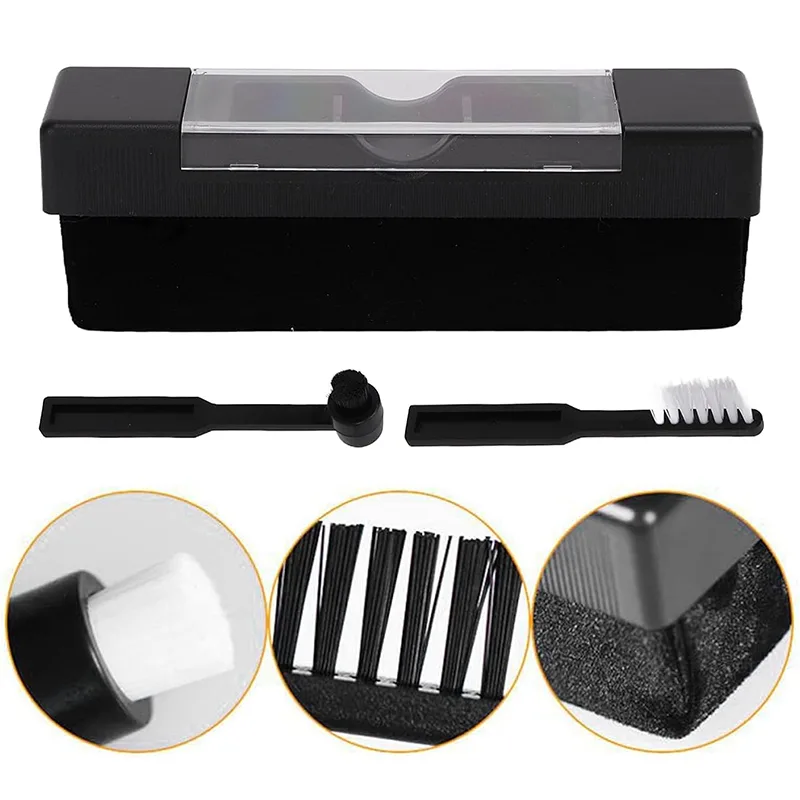
Retention is the property people notice first. Fine filaments sweep debris to the edge of the record, which works when you finish the pass properly and fails when you lift the brush mid-disc, because the load drops straight back into the grooves. A velvet face traps dust in the pile, so an interrupted pass is much less costly. You can also see the load, which tells you when it is time to clear the pad.
Maintenance is the second. Velvet takes a comb from a stiff nylon brush, and it can be washed and dried when it eventually needs it. A row of carbon filaments bends permanently if you push it the wrong way, and a brush dropped on a hard floor is often finished. That durability gap matters more in a busy household than any specification does.
The third is scale. A pad about 4.9 in (12.5 cm) long covers a wide arc of a 12 in (30 cm) record in a single rotation, so a full pass takes seconds and stays consistent from the outer edge to the run-out.
Side by side
| Criterion | Carbon fiber brush | Velvet pad brush |
|---|---|---|
| Reach into the groove | Filaments enter the groove itself | Rides the surface and the upper groove |
| Static charge | Conductive path to your hand when the metal contact is bare | No conductive path to ground |
| Contact area per pass | Narrow filament row | Wide continuous face |
| What happens to the dust | Swept toward the edge, released if you lift mid-disc | Held in the pile until you clear it |
| Cleaning the brush | Wipe across the fiber row, awkward to rinse | Re-comb with a stiff brush, washable |
| Durability | Filaments bend or break permanently | Pad tolerates drops and pressure |
| Common failure | Static claim fails when the handle is coated or held by the plastic | A loaded pad redeposits dust if it is never cleared |
| Storage | Fiber row exposed unless the case is used | Cover slides over the velvet face |
Which one belongs on your shelf
Our set is the second kind, and it is worth being precise about what that means. The block is a firm pad wrapped in black velvet, about 4.9 in (12.5 cm) long, with a clear sliding cover that protects the face on the shelf and acts as a handle in use. It is a velvet face and not a set of bristles, which several buyers pointed out in their reviews before we ever put it in writing. The set also includes a small stylus brush for the diamond and a white nylon detail brush whose real job is to re-comb the velvet.
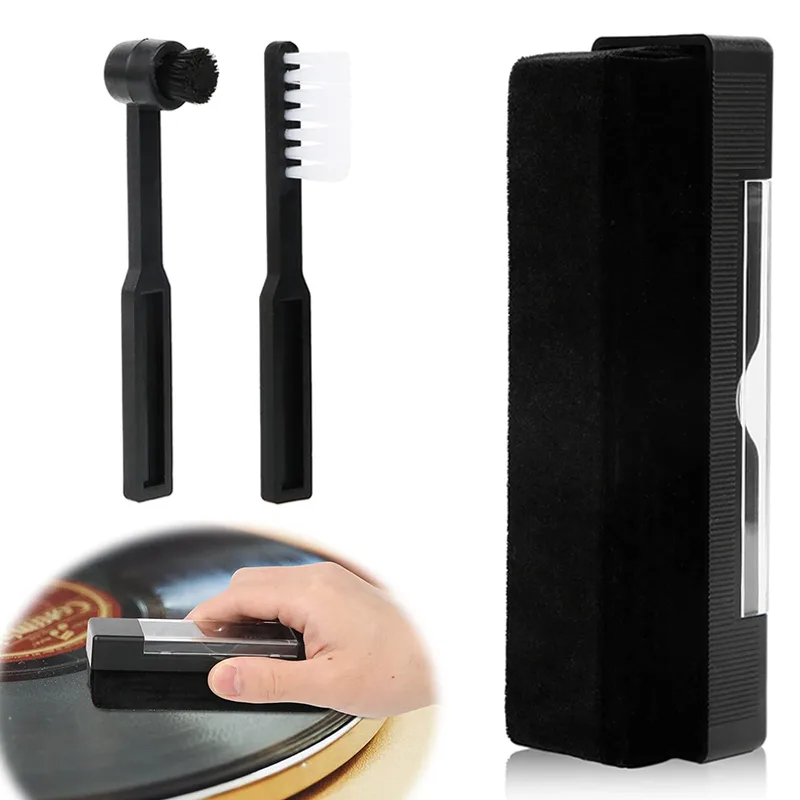
Across the 47 written buyer reviews (July 2026), four buyers, 9%, said explicitly that they expected bristles and found a pad. Dusting effectiveness was the most mentioned theme at 9 reviews, or 19%. The buyer feedback itself sits on the reviews page.
Plenty of collectors own both, use velvet before every play and keep carbon for records that click after they look clean. That is a sensible arrangement and we are not going to argue against it. What no brush of either kind can do is replace a wash. If a record is dirty rather than dusty, read how to clean vinyl records first and come back to brushes afterwards.
Short answers
Is a carbon fiber record brush anti-static?
It can be, and only if the charge has a path to somewhere. Carbon conducts, so the fibers need an unbroken connection through the handle to a bare metal contact and then to your hand. Hold the same brush by its plastic body and the anti-static function does nothing.
Can a velvet brush scratch a record?
The velvet itself will not. A velvet pad loaded with grit that has never been cleared can, because you are then dragging trapped particles across the surface. That is the argument for re-combing the pad regularly and for keeping the cover on between uses.
Do I need both a carbon fiber and a velvet brush?
One brush that matches your actual complaint does the work, and for most collections that complaint is dust on the surface. Our set answers it in three pieces: the velvet block for the record face, the stylus brush for the diamond, and the nylon brush that re-combs the pad so it keeps working. Storage handles the rest of the noise, as we set out in how to store vinyl records.
The velvet side of the argument
We sell the velvet design because it suits the job most people actually have, which is dust before every play. Three pieces, one job each, and a cover that keeps the velvet clean between sessions. The details are on the record cleaning kit page, the static question is treated at length on the anti-static record brush page, and the small brush has its own page at stylus brush.
More guides: all Tonebrush guides · cleaning a record player needle · the care routine · about Nick Talbot